
The Only Real Estate Platform Analyzing Economic, Environmental, and Infrastructure Risks – So You Don’t Have To
Analyze 20+ non-traditional metrics – from satellite-tracked infrastructure changes to 10-year weather risks – to make data-driven investment decisions no one else can.

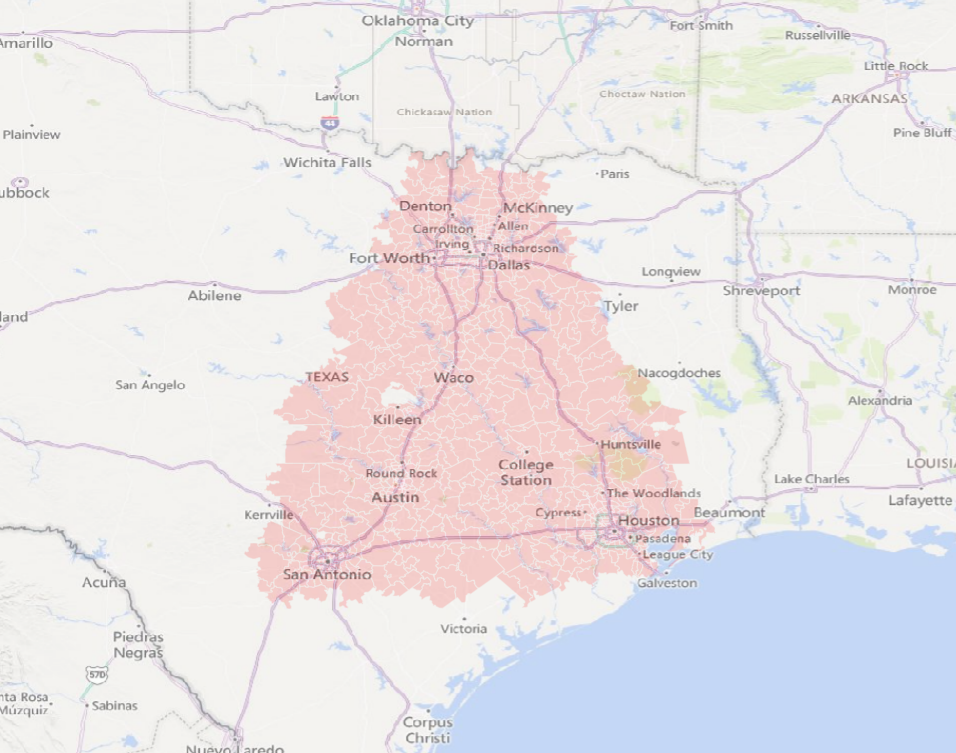
Our beta version features one of the most interesting Real Estate markets:
The Texas Triangle
Future investment
Spot High-Growth Areas Early: Map of Recently Announced Local Infrastructure & Economic Investments.
Economic metrics
Find the Most Economically Resilient Areas in Seconds – Backed by Years of Historical & Real-Time Data.
Housing
How Can ZIP-Code Housing Data Improve Your Acquisition, Pricing, and Risk Strategies? Find Out Here.
Population
This section provides current and historical population data at the ZIP code level, enabling tracking of demographic shifts.
Livability
Geologic data reveals soil stability and construction suitability that affect long-term property value. Atmospheric data reveal pollution levels, vegetation health and micro climate.
Weather
Analyze Historical Heating & Cooling Demand + Extreme Weather Hotspots with Interactive Maps – Visualize Past Climate Stress to Predict Future Energy Costs & Property Risks.
Built on a foundation of certainty—because every investment decision deserves the backing of real data, not intuition alone.
Science Blog
Kohlscheen, E. (2025). Forecasting House Prices. arXiv. https://doi.org/10.48550/arXiv.2509.21460
Using a random forest machine learning model on 35 years of data from 13 advanced economies, Kohlscheen (2025) finds that future house price appreciation is driven first and foremost by price momentum (past price increases tend to continue), followed by initial valuations (measured by price-to-rent ratios—lower ratios predict higher future growth) and household credit growth. Together, economic fundamentals explain the bulk of price movements across countries and time. The model dramatically outperforms traditional linear models, cutting forecast errors by over 40%. Notably, housing performs best when inflation is in the 0–3% range and becomes a poor inflation hedge when CPI inflation exceeds 5%. Country-specific factors matter surprisingly little, suggesting the same drivers work across all 13 countries.
–
Deutsche Bundesbank. (2013). The determinants and regional dependencies of house price increases since 2010 (Monthly Report, October 2013, pp. 13–29). Deutsche Bundesbank.
Deutsche Bundesbank (2013) examines why German residential property prices rose sharply after 2010, driven by strong economic growth, low mortgage rates, and heightened investor demand amid financial market uncertainty. Using a stock-flow equilibrium model across 402 districts, the study finds that demographic factors—especially the share of the population aged 30–55—along with population density, housing supply, and growth expectations are the key drivers of prices, while interest rates show no statistically measurable independent effect. It also finds that price increases are spreading spatially from cities to surrounding districts through both observable determinants and price-based transmission channels, suggesting overly optimistic expectations or speculation may be at play. Apartments in major cities appear overvalued by up to 20%, while single-family house prices remain broadly in line with fundamentals, and the report concludes that no substantial macroeconomic risks were yet present.
–
Inoue, T., Nishimura, K. G., Shimizu, C., & Deng, Y. (2017). Demography, credits and property prices: Evidence from a panel of diverse economies [Conference presentation]. Hitotsubashi–RIETI International Workshop, Tokyo, Japan.
Inoue et al. (2017) investigate how demographic composition and credit conditions affect residential property prices across a panel of 20 diverse economies from 1971 to 2015. Using panel cointegration techniques, they find that the young dependency ratio has strong positive effects on property prices, while the old dependency ratio has strong negative effects, and that the present-value relation explains a very high share of long-run price variation. Critically, they show that when a demographic bonus (young working-age dominance) coincides with easy credit, property prices rise substantially more than otherwise, while the opposite holds during a demographic onus—though the effect is weaker in aging economies. In the short run, prices adjust in a “bumpy” or hump-shaped manner, with shocks initially amplified and then reversed, and cyclical macro factors such as GDP-per-worker gaps and interest-rate gaps significantly influence prices beyond long-run fundamentals.